Research Journal Publisher,
Academic Institute, University,
Conference & Book Publishing
Support Services
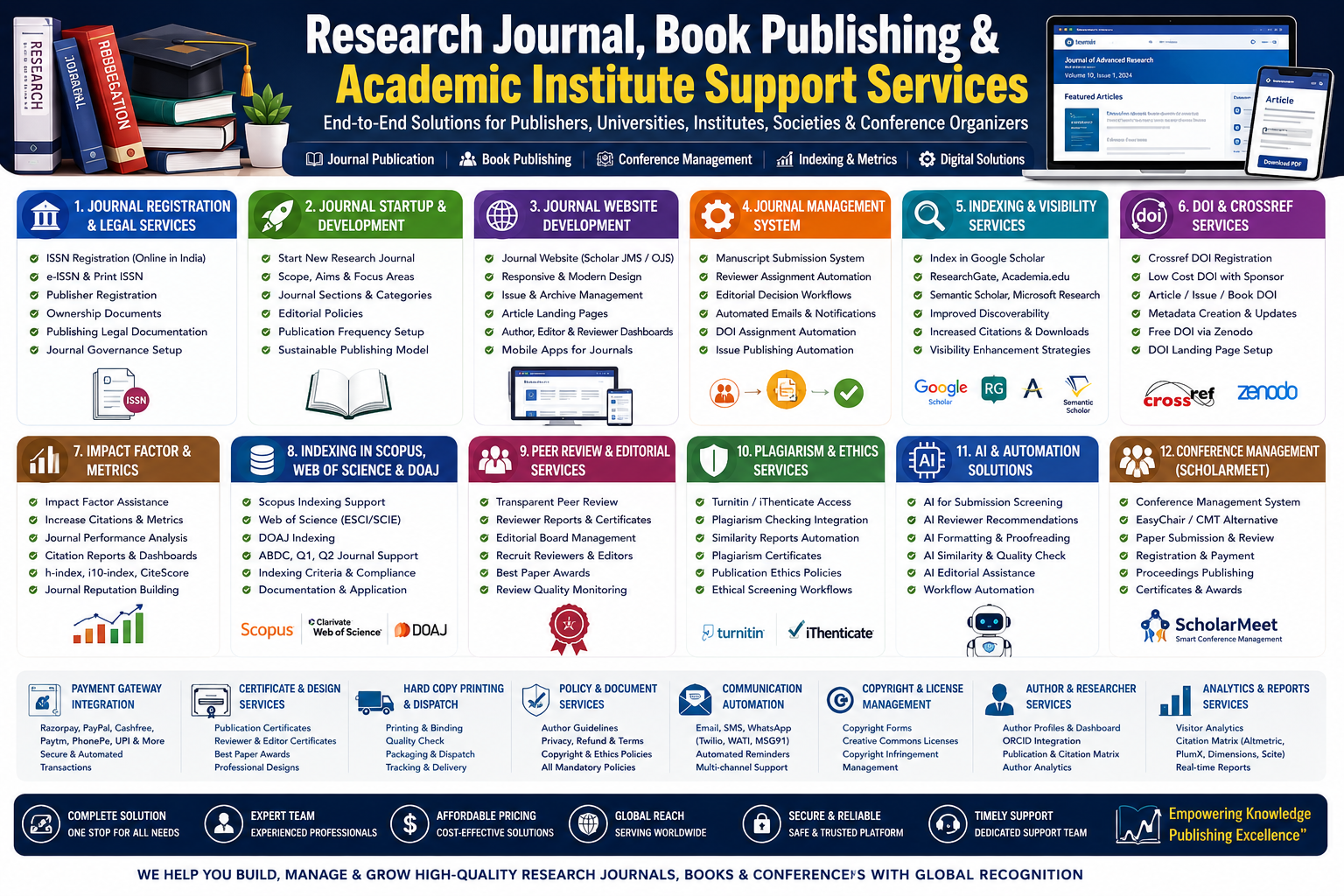
Expert consulting and end-to-end support for research journal publishers, academic institutes, universities, conferences, and book publishers worldwide. From ISSN registration and journal website development to Scopus indexing, impact factor improvement, peer review management, and complete publishing ecosystem setup.
Complete Academic Publishing Support for Journals, Universities & Conferences
Our comprehensive research journal publisher support services are designed for academic institutes, universities, research organizations, conference organizers, and independent publishers in India and worldwide. Whether you are starting a new research journal from scratch, seeking Scopus or Web of Science indexing, improving your impact factor, or building a professional publication platform — we provide expert guidance and technical support at every step.
We specialize in journal registration, ISSN obtainment, DOI registration through Crossref, journal website development using Scholar JMS and OJS, peer review workflow management, plagiarism checking integration, open access publishing models, conference management, book publishing, and complete digital transformation of academic publishing operations. Our services span everything from basic journal setup to advanced AI-powered automation, analytics dashboards, mobile apps, and full publishing ecosystems.
Browse our complete service directory below. Each topic links to a detailed guide with step-by-step instructions and expert recommendations — crafted to answer the most critical questions faced by journal publishers, academic institutes, and university research departments globally.
Complete Service Directory — Quick Navigation
1. Journal Registration & Setup Services 10
Complete guidance for starting, registering, and launching a new research journal in India and internationally
Starting a new research journal requires careful planning, proper registration, and the right documentation. Our journal registration and setup services guide you through every step — from obtaining your ISSN number and e-ISSN to defining your journal's aims and scope, setting up editorial workflows, and launching your first issue. Whether you are an individual researcher, an academic department, or a publishing organization, we help you build a credible, indexed, and professionally managed research journal from the ground up.
- How to get ISSN Number Registration Online in India and obtain an ISSN Certificate for a new research journal?
- How to apply for e-ISSN and Print ISSN for an online and print research journal?
- How to start a new research journal from scratch with complete setup and documentation?
- How to register a research journal publisher or publishing organization?
- How to create aims and scope for a new multidisciplinary research journal?
- How to decide journal title, journal abbreviation and publication frequency?
- How to create journal ownership documents and publisher declaration certificates?
- How to start an open access journal publication platform?
- How to launch a monthly, quarterly or yearly peer reviewed journal?
- How to create a journal publication workflow from submission to publication?
2. Journal Website Development Services 14
Professional journal websites using Scholar JMS, OJS, and custom platforms with full author and reviewer portals
A professional journal website is the foundation of a credible research publication. We develop high-performance, mobile-friendly journal websites with complete submission management, peer review workflows, author dashboards, reviewer portals, archive systems, and publication tracking pages. Whether you prefer Scholar JMS, OJS, or a custom-built platform, we ensure your journal website meets the technical and visual standards required for Google Scholar indexing, Scopus evaluation, and international recognition.
- How to create a professional research journal website?
- How to create a journal website using Scholar JMS?
- How to create a journal website using Open Journal Systems (OJS)?
- How to migrate from OJS to Scholar JMS without losing published papers?
- How to create a fast and mobile-friendly journal website?
- How to create journal archive pages with issue-wise publication?
- How to create article landing pages with DOI and citation information?
- How to create a journal website with author dashboard and reviewer dashboard?
- How to create article statistics, downloads and citation reports on journal website?
- How to create publication certificate download system in journal website?
- How to create publication tracking pages in a journal website?
- How to create paper status checking pages for authors?
- How to create online manuscript submission forms for research journals?
- How to create journal websites with multilingual support?
3. DOI, Crossref & Metadata Services 10
DOI registration, Crossref membership, XML metadata management, and free DOI alternatives through Zenodo
A Digital Object Identifier (DOI) is essential for every credible research publication. DOIs provide permanent links to published articles, enable citation tracking, and are required by most indexing databases including Scopus and Web of Science. We assist journals in joining Crossref, registering DOIs at low cost, managing XML metadata deposits, generating DOI landing pages, and connecting article DOIs with author ORCID profiles. We also guide journals on free DOI registration through Zenodo and other alternatives for budget-conscious publishers.
- How to get Crossref DOI registration for a research journal?
- How to get low cost DOI registration through Crossref sponsors?
- How to register DOI for journal articles, books and conference papers?
- How to get DOI metadata deposited in Crossref?
- How to update DOI metadata after publication?
- How to create DOI landing pages for journal articles?
- How to obtain free DOI alternatives through Zenodo?
- How to connect DOI with ORCID profiles?
- How to manage Crossref XML generation and submission?
- How to create automatic DOI generation systems?
4. Google Scholar & Research Indexing Services 10
Index journals and papers in Google Scholar, ResearchGate, Academia.edu, Semantic Scholar, and all major academic search platforms
Google Scholar indexing is one of the most important first steps for any new research journal. Indexed journals and articles receive significantly more visibility, citations, and manuscript submissions. We provide complete guidance on getting your journal and individual papers indexed in Google Scholar, ResearchGate, Academia.edu, Semantic Scholar, and other academic search engines. We also help optimize your journal website and article pages to maximize indexing speed and improve search engine visibility for academic audiences worldwide.
- How to index my journal in Google Scholar?
- How to index my paper in Google Scholar?
- How to index published papers in ResearchGate?
- How to index papers in Academia.edu?
- How to index papers in Semantic Scholar?
- How to improve visibility of journal articles in search engines?
- How to increase indexing speed of published articles?
- How to improve citation opportunities through indexing?
- How to create scholar-friendly article pages?
- How to optimize journal website for academic indexing?
5. Impact Factor, Journal Ranking & Citation Services 56
Guidance on obtaining, improving, and monitoring impact factor, citation scores, h-index, i10-index, h5-index, and international ranking
Journal impact factor and citation metrics are critical indicators of academic quality, reach, and influence. Whether you are aiming to get your first impact factor certificate, push your existing factor above 10, or build long-term citation growth strategies, our team provides comprehensive support. We help journals attract high-quality papers, optimize article metadata for discoverability, develop international authorship networks, create citation analytics dashboards, and build sustainable strategies for improving CiteScore, SJR, SNIP, h-index, and other key performance indicators. Every aspect of journal citation performance is covered under this service area.
- How to get impact factor for my journal?
- How to get impact factor above 10 for my journal?
- How to apply for journal impact factor evaluation?
- How to increase journal impact factor year by year?
- How to improve journal citation score and impact factor?
- How to calculate impact factor of a research journal?
- How to check current impact factor of my journal?
- How to get international impact factor for a journal?
- How to get global impact factor for a journal?
- How to obtain journal ranking and citation metrics?
- How to improve journal quality for higher impact factor?
- How to increase citations of published papers?
- How to increase h-index of a journal?
- How to increase i10-index of a journal?
- How to improve journal h5-index?
- How to improve journal citation performance?
- How to create citation growth strategies for journals?
- How to improve article visibility for more citations?
- How to increase Google Scholar citations?
- How to improve journal author citation rates?
- How to increase international citations for journal papers?
- How to improve journal reputation and authority?
- How to attract high-quality papers to improve impact factor?
- How to select papers that receive more citations?
- How to identify highly cited research topics?
- How to create citation reports for journals?
- How to create impact factor reports for publishers?
- How to track citation performance of published papers?
- How to analyze journal citation trends?
- How to create citation analytics dashboards?
- How to compare impact factor with competitor journals?
- How to improve journal acceptance quality for citation growth?
- How to reduce self-citation risks in journals?
- How to create ethical citation strategies?
- How to improve journal international collaboration?
- How to increase journal downloads and readership?
- How to attract international authors to improve impact factor?
- How to improve journal indexing for better citations?
- How to optimize article metadata for citation growth?
- How to create citation networks for published papers?
- How to monitor article-level citation performance?
- How to create annual journal impact reports?
- How to evaluate journal influence and research impact?
- How to improve journal academic visibility worldwide?
- How to create research impact measurement systems?
- How to benchmark journal performance against Scopus indexed journals?
- How to benchmark journal performance against Web of Science journals?
- How to improve journal ranking in academic databases?
- How to create publisher-wide citation monitoring systems?
- How to identify low-citation articles and improve visibility?
- How to improve journal impact through special issues?
- How to improve citation performance through review articles?
- How to create highly cited special issue collections?
- How to attract leading researchers to publish in journals?
- How to improve journal prestige and international recognition?
- How to build a long-term strategy for achieving high impact factor journals?
- How to evaluate journal quality indicators?
- How to create impact analysis dashboards for journals?
6. Alternative Metrics & Research Impact Services 10
Integrate Altmetric, PlumX, Scite Smart Citations, Dimensions, and article-level attention scores into your journal platform
Traditional citation counts alone no longer capture the full reach of research. Alternative metrics (altmetrics) measure social media mentions, news coverage, policy document references, blog posts, and online attention that a research article receives. We help journals integrate Altmetric badges, PlumX metrics, Scite Smart Citations, and Dimensions data directly into article pages — giving readers, authors, and funders a richer picture of research impact beyond traditional bibliometrics.
- How to integrate Altmetric badges in journal websites?
- How to integrate PlumX metrics in journals?
- How to integrate Scite Smart Citations?
- How to integrate Dimensions citation metrics?
- How to display article attention scores?
- How to track social media impact of research papers?
- How to create article-level metrics dashboards?
- How to display real-time citation counts?
- How to measure research impact beyond traditional impact factor?
- How to create complete journal metrics and analytics systems?
7. Scopus Indexing Services 12
Prepare, apply, and maintain Scopus indexing — from quality improvement to evaluation and reapplication after rejection
Scopus indexing is one of the most prestigious benchmarks of journal quality and is a major requirement for authors in many academic institutions worldwide. Getting indexed in Scopus requires meeting strict quality standards for editorial board diversity, peer review rigor, citation performance, journal website quality, and publication regularity. Our Scopus indexing consulting service provides a complete roadmap: assessing your journal's current readiness, identifying gaps, preparing all required documentation, guiding the application process, and supporting reapplication if rejected.
- How to index a journal in Scopus?
- How to apply for Scopus journal indexing?
- What are the Scopus journal selection criteria?
- How to prepare a journal for Scopus evaluation?
- How to meet Scopus Journal indexing standard requirements?
- How to improve journal quality before Scopus submission?
- How long does Scopus journal evaluation take?
- How to check Scopus journal application status?
- How to increase the chances of Scopus acceptance?
- How to resolve Scopus rejection and reapply?
- How to maintain Scopus indexed journal status?
- How to prepare all documents required for journal indexing?
8. Web of Science Indexing Services 10
Expert guidance for Web of Science ESCI, SCIE, SSCI, and AHCI journal indexing applications
Web of Science (WoS) is the gold standard of academic journal indexing and is used globally for research evaluation, grant applications, and institutional rankings. Journals indexed in WoS — particularly in the Science Citation Index Expanded (SCIE), Social Sciences Citation Index (SSCI), and Arts & Humanities Citation Index (AHCI) — command the highest academic prestige. The Emerging Sources Citation Index (ESCI) provides a pathway for newer journals. We guide publishers through every stage of the WoS application process.
- How to index a journal in Web of Science?
- How to apply for Web of Science journal indexing?
- What are the Web of Science journal selection criteria?
- How to qualify for ESCI indexing?
- How to move from ESCI to SCIE indexing?
- How to qualify for SSCI indexing?
- How to qualify for AHCI indexing?
- How to improve journal quality for Web of Science evaluation?
- How to prepare documents for Web of Science submission?
- How to increase acceptance chances in Web of Science?
9. DOAJ Indexing Services 10
Directory of Open Access Journals — indexing guidance, open access policy preparation, and application support
DOAJ (Directory of Open Access Journals) is the most authoritative global index of open access research journals. Inclusion in DOAJ signals transparency, editorial quality, and ethical publishing practices — and is required for many other indexing databases and funding agency compliance. We assist journals in meeting DOAJ's strict inclusion criteria, preparing open access policies, improving editorial transparency, and navigating the application and review process. We also help journals understand and avoid common rejection reasons and maintain their DOAJ listing after acceptance.
- How to index a journal in DOAJ?
- How to apply for DOAJ indexing?
- What are the DOAJ inclusion criteria?
- How to prepare journal policies for DOAJ approval?
- How to improve transparency for DOAJ acceptance?
- How to create open access policies for DOAJ?
- How to avoid common DOAJ rejection reasons?
- How to maintain DOAJ indexed journal status?
- How to update journal information in DOAJ?
- How to improve journal visibility through DOAJ?
10. ABDC Indexing & Ranking Services 10
Australian Business Deans Council Journal Quality List — application, ranking improvement, and A*/A/B/C category strategies
The ABDC Journal Quality List is a highly regarded ranking system used by business schools and management faculties globally. Journals are classified into four categories — A*, A, B, and C — based on editorial quality, peer review rigor, citation performance, and academic influence. Our ABDC indexing consulting service helps journals prepare for evaluation, understand specific quality criteria for each category, and build strategies to move up from lower to higher ranking tiers over time.
- How to index a journal in ABDC?
- How to apply for ABDC Journal Quality List inclusion?
- What are ABDC journal selection criteria?
- How to improve journal ranking for ABDC consideration?
- How to prepare journal documentation for ABDC evaluation?
- How to increase journal quality indicators for ABDC?
- How to maintain ABDC journal listing?
- How to understand ABDC A*, A, B and C categories?
- How to improve journal ranking from C to B or A category?
- How to create long-term ABDC indexing strategies?
11. Q1, Q2, Q3 & Q4 Journal Ranking Services 15
Understanding quartile rankings, improving CiteScore and SJR, and building a strategy to move your journal to a higher quartile in Scopus
Journal quartile rankings (Q1 to Q4) are assigned based on a journal's CiteScore rank within its subject category in Scopus. Q1 represents the top 25% of journals and Q4 the bottom 25%. These rankings directly affect where researchers choose to submit their best work and how institutional research evaluation committees rate publications. We provide comprehensive consulting on understanding quartile metrics, improving CiteScore and SJR scores, and building a multi-year plan to move your journal from Q4 up to Q1.
- What is a Q1 Journal?
- What is a Q2 Journal?
- What is a Q3 Journal?
- What is a Q4 Journal?
- How is journal quartile ranking calculated?
- How to check whether a journal is Q1 or Q2?
- How to move a journal from Q4 to Q3?
- How to move a journal from Q3 to Q2?
- How to move a journal from Q2 to Q1?
- How to improve journal CiteScore for better quartile ranking?
- How to improve journal SJR score?
- How to improve journal SNIP score?
- How to improve journal international ranking?
- How to achieve Q1 journal standards?
- How to compare journal performance with Q1 journals?
12. Journal Evaluation & Readiness Assessment 10
Comprehensive journal audits and readiness assessments before applying for Scopus, WoS, DOAJ, and other major databases
Before applying for any major indexing database, it is essential to conduct a thorough journal quality audit. Premature applications not only get rejected but can also trigger cooling-off periods that delay your indexing timeline by years. Our journal evaluation and readiness assessment service covers all critical dimensions: editorial board composition, peer review process quality, publication ethics standards, website technical requirements, citation performance benchmarks, metadata quality, and historical publication consistency. We deliver a detailed gap analysis and an actionable improvement roadmap.
- How to perform Scopus readiness assessment for journals?
- How to perform Web of Science readiness assessment?
- How to perform DOAJ readiness assessment?
- How to identify weaknesses before indexing applications?
- How to conduct journal quality audits?
- How to evaluate editorial board quality?
- How to evaluate publication ethics standards?
- How to evaluate journal website quality?
- How to evaluate journal citation performance?
- How to create indexing improvement roadmaps?
13. Abstracting & Indexing Databases 15
Index your journal in EBSCO, ProQuest, J-Gate, WorldCat, Ulrichsweb, ROAD, OpenAIRE, BASE, ICI, CNKI, Dimensions, and more
Beyond the major indexing databases, a wide range of specialized abstracting and indexing services significantly increase a journal's discoverability, credibility, and citation opportunities. Getting indexed in databases such as EBSCO, ProQuest, J-Gate, Ulrichsweb, WorldCat, Indian Citation Index (ICI), CNKI, Dimensions, and Semantic Scholar expands your journal's readership across academic institutions, libraries, and research platforms worldwide. We provide journal-specific metadata preparation and step-by-step application support for each database.
- How to index my journal in ROAD Directory?
- How to index my journal in OpenAIRE?
- How to index my journal in BASE?
- How to index my journal in WorldCat?
- How to index my journal in CNKI?
- How to index my journal in EBSCO?
- How to index my journal in ProQuest?
- How to index my journal in Ulrichsweb?
- How to index my journal in J-Gate?
- How to index my journal in Indian Citation Index (ICI)?
- How to index a journal in Semantic Scholar?
- How to index a journal in Dimensions?
- How to index a journal in Crossref Metadata Search?
- How to prepare metadata for international indexing databases?
- How to index a journal in PubMed and MEDLINE?
- How to index a journal in EMBASE?
- How to create a complete indexing strategy for Journal Publication growth?
14. Peer Review & Editorial Management Services 15
Complete peer review workflow setup, reviewer recruitment, editorial board management, and review certificate systems
Rigorous peer review is the cornerstone of credible academic publishing and the primary criterion evaluated by Scopus, Web of Science, and DOAJ during journal assessment. We help journals implement transparent, double-blind, and single-blind peer review processes; recruit qualified international reviewers and editorial board members; automate reviewer assignment; manage turnaround times; and create recognition systems for reviewers and editors. Our services also cover Transparent Peer Review publishing and building reviewer referral networks to maintain a healthy pool of qualified experts across disciplines.
- How to implement Transparent Peer Review in a journal?
- How to create peer review certificates for reviewers?
- How to create reviewer recognition systems?
- How to create editorial board certificates?
- How to manage editors and reviewers in a journal?
- How to assign reviewers automatically?
- How to create reviewer recommendation systems?
- How to recruit international reviewers?
- How to recruit editorial board members?
- How to invite professors and researchers as editors?
- How to evaluate reviewer performance?
- How to manage peer review turnaround time?
- How to create double blind peer review systems?
- How to create single blind peer review systems?
- How to manage reviewer referral programs?
15. Plagiarism Checking Services 10
Turnitin, iThenticate, and AI content detection integration — automated screening and ethics workflows for journals
Plagiarism detection is no longer optional — it is an absolute requirement for any credible peer-reviewed journal. Publishers must screen every submitted manuscript for text similarity, duplicate publication, and increasingly, AI-generated content before sending it for peer review. We help journals integrate Turnitin, iThenticate, and free tools into their submission workflows, automate plagiarism reports, create plagiarism certificates, and build end-to-end publication ethics screening systems. We also provide guidance on handling plagiarism complaints and managing retraction decisions in compliance with COPE guidelines.
- How to get Turnitin for my journal?
- How to get iThenticate for my journal publication process?
- How to integrate plagiarism checking in journal submission workflow?
- How to automate plagiarism reports?
- How to create plagiarism certificates?
- How to verify originality before publication?
- How to manage plagiarism complaints?
- How to create publication ethics workflows?
- How to detect AI generated content in research papers?
- How to create ethical screening systems for journals?
16. AI Automation Services 10
Integrate artificial intelligence into journal workflows for manuscript screening, reviewer matching, formatting, and publication operations
Artificial intelligence is transforming academic publishing by automating time-consuming editorial tasks, reducing human error, and accelerating publication timelines. We help journals and publishers integrate AI tools for manuscript screening and desk rejection, automated reviewer recommendation systems, AI-assisted language improvement, article formatting automation, citation verification, and complete publication workflow automation. We also develop custom AI-powered editorial assistant tools and journal recommendation systems that match submitted manuscripts to the most appropriate journals.
- How to integrate AI into journal publication workflows?
- How to use AI for manuscript screening?
- How to use AI for reviewer recommendations?
- How to use AI for article formatting?
- How to use AI for language improvement?
- How to use AI for publication workflow automation?
- How to use AI for citation checking?
- How to create AI-powered editorial assistants?
- How to create AI-powered journal recommendation systems?
- How to automate publication operations using artificial intelligence?
17. Author Communication & Automation Services 10
Automate email, WhatsApp (WATI), SMS, and Twilio notifications for submissions, acceptances, rejections, and publications
Effective and timely communication with authors, reviewers, and editors is essential for maintaining a professional journal. Manual email management becomes unmanageable as submission volumes grow. We help journals automate their entire communication stack — from submission confirmation and review assignment emails to acceptance letters, revision reminders, payment confirmations, and publication announcements. We integrate WhatsApp Business automation through WATI, SMS notifications via Twilio, and multi-channel systems that keep every stakeholder informed at every stage.
- How to automate author communication through email?
- How to automate WhatsApp notifications for journal submissions?
- How to integrate SMS notifications in journal websites?
- How to integrate Twilio with journal websites?
- How to integrate WATI with journal websites?
- How to automate acceptance and rejection emails?
- How to automate reviewer reminders?
- How to automate publication notifications?
- How to create email templates for journal communication?
- How to manage multi-channel communication with authors?
18. Payment Gateway & Processing Fee Management 10
Integrate Razorpay, Cashfree, PayPal, PhonePe, UPI — automate invoices, GST billing, and international payment management
Managing publication processing charges (APCs) efficiently is critical for running a financially sustainable journal. We help journals integrate the most appropriate payment gateways for their author base — Razorpay and Cashfree for Indian authors, PayPal for international payments, PhonePe, Paytm, and UPI for domestic transactions. Our services also cover automatic invoice generation, GST-compliant billing, multi-currency payment support, refund management, and complete financial reporting systems that ensure payment collection is seamless and fully automated.
- How to decide publication processing charges for journals?
- How to integrate Razorpay in a journal website?
- How to integrate Cashfree payment gateway?
- How to integrate PayPal for international publication fees?
- How to integrate PhonePe and Paytm payments?
- How to integrate UPI payment systems?
- How to automate publication fee receipts?
- How to automate invoices and GST billing?
- How to manage international author payments?
- How to create publication fee management systems?
19. Journal Policy & Documentation Services 13
Create author guidelines, ethics policies, copyright, privacy, retraction, conflict of interest, and AI usage policy documents
Well-documented journal policies are a critical requirement for indexing database applications and for maintaining author trust. Indexing evaluators specifically review author guidelines, peer review policies, ethics statements, copyright terms, retraction and correction policies, and conflict of interest declarations when assessing journal quality. We create complete, professionally worded policy documents tailored to your journal's scope, publication model, and target indexing databases — ensuring full compliance with COPE, ICMJE, and other international publication ethics standards.
- How to create author guidelines for research journals?
- How to create reviewer guidelines?
- How to create editor guidelines?
- How to create publication ethics policies?
- How to create copyright policies?
- How to create privacy policies?
- How to create refund policies?
- How to create terms and conditions pages?
- How to create retraction policies?
- How to create withdrawal policies?
- How to create conflict of interest policies?
- How to create data availability policies?
- How to create AI usage policies for journals?
20. Copyright & Licensing Services 10
Copyright transfer forms, author undertaking agreements, Creative Commons licensing, and intellectual property rights management
Copyright and licensing management is a legally sensitive area of academic publishing. Authors, institutions, and journals all have rights and obligations regarding published content. We create customized copyright transfer agreements, author undertaking forms, publication contracts, and Creative Commons license policies suited to your journal's publishing model. For open access journals, we advise on the most appropriate Creative Commons license type (CC BY, CC BY-SA, CC BY-NC, etc.) and help register these policies in global repositories. We also handle copyright infringement complaints.
- How to create copyright transfer forms?
- How to create author undertaking forms?
- How to create publication agreements?
- How to manage copyright infringement complaints?
- How to use Creative Commons licenses in journals?
- How to choose CC BY, CC BY-SA and other Creative Commons licenses?
- How to manage intellectual property rights?
- How to create open access licensing policies?
- How to protect journal content from misuse?
- How to manage legal issues related to journal publications?
21. Conference Management Services 11
Complete academic conference management — ScholarMeet, EasyChair/CMT replacement, proceedings, certificates, and journal integration
Managing academic conferences online requires robust submission, review, and publication systems. Many institutions are moving away from EasyChair and Microsoft CMT toward more flexible, cost-effective, and integrated solutions. We offer complete conference management services using ScholarMeet and custom platforms — covering submission portals, blind review assignment, acceptance and rejection workflows, conference proceedings publication, conference website development, MOU preparation for institutional collaborations, and complete registration and certificate management.
- How to manage academic conferences online?
- How to create conference submission systems?
- How to replace EasyChair for conference management?
- How to replace Microsoft CMT for conference management?
- How to manage conference reviews and paper acceptance?
- How to publish conference papers in journals?
- How to create conference proceedings?
- How to create conference websites?
- How to design MOU for conference collaboration?
- How to manage conference registrations and certificates?
- How to use ScholarMeet for conference and event management?
22. Book Publishing Services 19
ISBN registration, eBook, print-on-demand, Amazon KDP, edited volumes, thesis publication, royalty management, and worldwide distribution
Academic book publishing opens additional revenue and impact opportunities for research publishers, academic institutes, and universities. We provide end-to-end book publishing support — from obtaining ISBN numbers in India and internationally, to publishing edited volumes, conference proceedings, theses, dissertations, and research monographs. Our book publishing services cover both digital (eBook, Kindle, ePub) and physical (print-on-demand) formats. We help publishers list books on Amazon KDP, distribute them worldwide, create royalty management systems, and develop book marketing campaigns to maximize academic reach and sales.
- How to publish academic books online?
- How to get ISBN registration for books?
- How to obtain ISBN in India for academic books?
- How to publish edited books?
- How to publish edited volumes and conference books?
- How to publish conference proceedings books?
- How to publish thesis as a book?
- How to publish dissertations as books?
- How to publish eBooks and print books?
- How to create print-on-demand book publishing systems?
- How to create book publication certificates?
- How to manage book distribution and sales?
- How to create Amazon Kindle eBooks?
- How to publish books on Amazon KDP?
- How to distribute books worldwide?
- How to create book royalty management systems?
- How to create author royalty reports?
- How to manage book inventory and orders?
- How to create book marketing and promotion campaigns?
23. Advanced Journal Technology Services 30
JATS XML, OAI-PMH, LOCKSS/CLOCKSS, ePub, APA/MLA/IEEE citation styles, plugin systems, and full publishing ecosystem development
Modern academic publishing requires a sophisticated technical stack that supports multiple article formats, metadata standards, digital preservation, citation management, and advanced discovery features. We provide comprehensive technical publishing services including JATS XML generation, OAI-PMH metadata harvesting protocols, LOCKSS and CLOCKSS digital preservation integration, ePub and HTML article formats, citation style generation for APA, MLA, IEEE, Harvard, Vancouver, and Chicago. We also develop plugin architectures, institutional repository systems, research databases, and complete end-to-end publishing ecosystems for multi-journal publishers and universities.
- How to create author profiles in journal websites?
- How to create researcher profiles with publication history?
- How to create citation dashboards for authors?
- How to create article citation graphs?
- How to integrate ORCID in journal websites?
- How to manage XML publishing formats?
- How to generate JATS XML for publications?
- How to implement OAI-PMH metadata harvesting?
- How to integrate LOCKSS and CLOCKSS preservation systems?
- How to create HTML article formats?
- How to create PDF publication formats?
- How to create ePub publication formats?
- How to manage keyword indexing and keyword clouds?
- How to create citation styles such as APA, MLA, IEEE, Harvard, Vancouver and Chicago?
- How to manage references and bibliography systems?
- How to integrate Altmetric, PlumX, Dimensions and Scite metrics?
- How to create article sharing systems for social media?
- How to create visitor analytics and publication statistics?
- How to create plugin-based journal systems?
- How to integrate plagiarism, DOI and payment plugins?
- How to create FAQ pages, sitemap pages and static pages for journals?
- How to create Call for Papers pages?
- How to create publication announcement pages?
- How to create real-time article tracking systems?
- How to create article recommendation engines?
- How to create journal finder and journal recommendation tools?
- How to create reviewer finder and reviewer recommendation systems?
- How to create institutional repository systems?
- How to create publication databases and research repositories?
- How to create complete journal publication ecosystems for publishers and universities?
24. Complete Journal Publisher & Institute Consulting 10
End-to-end consulting for publishers, academic institutes, and universities seeking complete digital academic publishing transformation
For publishers, academic institutes, and universities that need comprehensive, long-term publishing support rather than individual service engagements, we offer complete consulting packages covering every dimension of research publication management. From setting up an entire publication ecosystem from scratch to transforming an existing traditional publishing operation into a modern, automated, globally indexed digital platform — our complete consulting service provides dedicated expert guidance, implementation support, staff training, and ongoing strategic management.
- Complete Journal Publication Setup and Management Services
- Complete Peer Review Journal Publication Consulting
- Complete UGC CARE Approved Journal Publication Consulting
- Complete Scopus Journal Indexing Standard Consulting
- Complete Crossref DOI Registration Consulting
- Complete Conference and Journal Integration Consulting
- Complete Publisher Digital Transformation Consulting
- Complete Academic Institute Publication Consulting
- Complete University Journal Management Consulting
- Complete Research Publication Ecosystem Development Services
25. Journal Security & Infrastructure Services 10
Protect journals from hacking, DDoS, spam — cloud hosting on AWS, Azure, Google Cloud with CDN and load balancing
Journal websites store sensitive author data, unpublished manuscripts, reviewer identities, and payment information — making security a top priority. We help journals implement comprehensive security frameworks including SSL/HTTPS, WAF (Web Application Firewall), DDoS protection, spam submission filters, and malware scanning. Our infrastructure services cover cloud hosting setup on AWS, Azure, and Google Cloud, CDN integration for global speed optimization, automatic backup and disaster recovery systems, uptime monitoring, and server scaling for high-traffic journals.
- How to secure my journal website from hacking, malware, spam submissions and DDoS attacks?
- How to implement SSL certificates and HTTPS security in my journal website?
- How to create automatic backup and disaster recovery systems for journal websites?
- How to migrate journal websites from one hosting provider to another?
- How to manage multiple journals from a single publisher dashboard?
- How to create journal CDN and speed optimization systems?
- How to monitor journal website uptime and performance?
- How to create journal hosting infrastructure on AWS, Azure and Google Cloud?
- How to create load balancing systems for high traffic journal websites?
- How to protect journal data and author information?
26. ORCID & Researcher Identity Services 6
ORCID login integration, researcher profile pages, identity verification, and automatic publication record synchronization
ORCID (Open Researcher and Contributor ID) provides a persistent digital identifier that distinguishes researchers from one another and connects their publications, grants, and affiliations across institutions and databases. Integrating ORCID into your journal platform is increasingly required by major funders and indexing databases, and significantly improves author trust and manuscript quality. We implement ORCID login, automated profile linking, researcher identity verification, and publication record synchronization — creating a seamless connection between your journal and the global researcher identity ecosystem.
- How to integrate ORCID login and registration in my journal?
- How to automatically connect author ORCID profiles with publications?
- How to verify researcher identity through ORCID?
- How to create researcher profile pages linked with ORCID?
- How to synchronize publication records with ORCID?
- How to create institutional researcher directories?
27. Research Integrity & Ethics Services 10
Handle misconduct, duplicate publications, paper mills, retractions, AI content verification, and COPE-compliant ethics workflows
Research integrity has become a central concern for academic publishers as incidents of misconduct, duplicate publication, paper mill submissions, and AI-generated content continue to rise. Journals must have clear, documented procedures for investigating and resolving these issues in compliance with COPE (Committee on Publication Ethics) guidelines. We help journals establish ethics committees, create investigation workflows for misconduct complaints, develop paper mill detection strategies, implement AI content verification protocols, and manage article corrections, errata, and retractions with full transparency.
- How to handle research misconduct cases in my journal?
- How to investigate duplicate publication cases?
- How to detect paper mill submissions?
- How to create publication ethics committees for journals?
- How to handle author disputes and complaints?
- How to create correction and erratum workflows?
- How to manage article retractions and withdrawals?
- How to verify AI-generated content in research papers?
- How to create ethics approval verification systems?
- How to create conflict of interest disclosure systems?
28. Open Access Publishing Services 8
Gold, Diamond, and Hybrid open access models — APC policies, self-archiving compliance, and open access visibility strategies
Open access publishing has become the dominant model in academic research, driven by funder mandates, institutional policies, and the global push for free knowledge dissemination. Publishers must choose the right open access model — Gold (author-pays), Diamond (no-charge to authors or readers), or Hybrid (mix of subscription and open access) — and implement appropriate licensing, APC policies, and self-archiving provisions. We provide complete guidance on designing and implementing open access strategies that improve journal visibility, increase citation rates, and fulfill funder requirements.
- How to create an open access journal publication model?
- How to implement Gold Open Access publishing?
- How to implement Diamond Open Access publishing?
- How to implement Hybrid Open Access publishing?
- How to create article processing charge policies?
- How to create self-archiving policies for authors?
- How to register journal open access policies?
- How to increase visibility through open access publishing?
29. Journal Marketing & Promotion Services 10
Promote journals worldwide, attract manuscript submissions, email campaigns, social media marketing, and author acquisition programs
A well-run journal needs a steady flow of high-quality manuscript submissions to maintain publication consistency and improve citation metrics. Marketing and promotion are as important as quality control in today's competitive academic publishing landscape. We develop comprehensive journal marketing strategies including targeted email campaigns to researchers in specific disciplines, social media promotion across LinkedIn, ResearchGate, Twitter, and Facebook, author acquisition programs, Call for Papers campaigns, journal branding materials, and digital advertisements that attract high-impact researchers and improve journal brand recognition.
- How to promote a new research journal worldwide?
- How to attract more manuscript submissions?
- How to increase journal website traffic?
- How to market journals through email campaigns?
- How to market journals through social media?
- How to create author acquisition campaigns?
- How to attract international researchers?
- How to improve journal brand recognition?
- How to create journal brochures and promotional materials?
- How to design journal advertisements and banners?
30. Journal Revenue & Business Development Services 8
Build sustainable journal business models, manage revenue streams, develop sponsorships, and create institutional partnership programs
Running a financially sustainable research journal requires a well-designed business model that balances quality publishing with revenue generation. Journal publishers can earn through article processing charges, institutional subscriptions, sponsorships, advertising, conference partnerships, and book publishing. We help publishers design appropriate revenue models for their audience, manage financial reporting, build institutional subscription systems, create sponsorship programs for industry partners, develop affiliate networks, and establish long-term revenue diversification strategies that ensure the journal's financial health while maintaining editorial independence.
- How to generate revenue from journal publication?
- How to create sustainable journal business models?
- How to manage journal accounting and financial reports?
- How to manage publisher revenue streams?
- How to create journal sponsorship programs?
- How to create institutional subscription systems?
- How to manage publisher partner programs?
- How to create affiliate programs for journal promotion?
31. Journal Reporting & Analytics Services 9
Editor and reviewer performance reports, submission statistics, acceptance ratios, author demographics, and country-wise analytics
Data-driven decision making is essential for continuously improving journal quality and operational efficiency. We design and implement comprehensive reporting systems that give journal editors, managing editors, and publishers real-time access to all key performance indicators. From submission volume trends and peer review turnaround times to geographic distribution of authors, acceptance and rejection ratios, and citation growth — our analytics dashboards provide actionable insights. We also create annual performance reports for editorial boards, funders, and indexing database reviews, ensuring complete transparency and accountability.
- How to create editor performance reports?
- How to create reviewer performance reports?
- How to create publication trend reports?
- How to create submission statistics dashboards?
- How to create acceptance and rejection ratio reports?
- How to create author demographic reports?
- How to create country-wise publication reports?
- How to create citation growth reports?
- How to create annual publisher reports?
32. Research Data & Supplementary Files Services 7
Manage datasets, multimedia files, video abstracts, graphical abstracts, data repositories, and data availability compliance
Modern research publishing increasingly requires journals to support supplementary data, multimedia files, research datasets, video abstracts, and graphical abstracts alongside traditional text articles. Publishers must also comply with funder data availability mandates by creating clear data availability statement workflows and supporting open data repositories. We help journals build technical infrastructure for accepting, hosting, and displaying supplementary research materials — including assigning separate DOIs to datasets and creating institutional data repositories.
- How to manage supplementary files for journal articles?
- How to publish research datasets with journal papers?
- How to create data repositories for journals?
- How to assign DOI to datasets?
- How to manage multimedia files with research papers?
- How to publish video abstracts and graphical abstracts?
- How to create data availability statement workflows?
33. Advanced Publishing Features 10
Article versioning, online-first publication, continuous publishing, citation alerts, multilingual platforms, and article translation systems
Cutting-edge journals are adopting advanced publishing features that enhance reader experience, increase citation rates, and improve accessibility. Online-first publication allows articles to be discoverable and citable immediately after acceptance — before formal issue assignment. Continuous publication models eliminate rigid issue schedules and accelerate research dissemination. Citation alert systems keep readers informed when new articles cite work they track. Multilingual platforms open journals to non-English-speaking research communities. We implement all of these features and more, helping journals stay at the forefront of academic publishing innovation.
- How to create article versioning systems?
- How to publish articles online first before issue publication?
- How to create continuous publication workflows?
- How to create article recommendation engines?
- How to create related article suggestions?
- How to create citation alert systems?
- How to create article bookmark and favorite systems?
- How to create article commenting and discussion systems?
- How to create article translation systems?
- How to create multilingual journal publication platforms?
34. University & College Publishing Services 7
University-owned journals, institutional repositories, faculty publications, accreditation support, and university press systems
Universities and colleges have unique publishing needs that combine research output management, accreditation compliance, faculty evaluation, and institutional branding. We help academic institutions create and manage their own research journals, build institutional repositories for faculty publications, publish conference proceedings from institutional events, develop university press operations, and create research output reporting systems that satisfy NAAC, NBA, NIRF, and other accreditation and ranking requirements. All institutional publications are brought to international quality standards while serving the documentation and reporting needs of the institution.
- How to create university-owned research journals?
- How to manage institutional journals for colleges and universities?
- How to create faculty publication repositories?
- How to publish university conference proceedings?
- How to create university press publishing systems?
- How to manage accreditation publication requirements?
- How to create research output management systems for universities?
35. Mobile App Services 6
Android and iOS apps for journals, conferences, authors, and reviewers — with push notifications and offline reading
Mobile applications extend journal reach to researchers who prefer accessing content on smartphones and tablets. A dedicated journal mobile app provides push notification capabilities for new publications, submission status updates, reviewer assignment alerts, and conference announcements — maintaining engagement between authors, reviewers, and editorial teams. We develop native Android and iOS apps for research journals and conferences, with features including offline article reading, author submission tracking, reviewer management interfaces, and real-time publication notifications that significantly improve author and reviewer experience.
36. Publication Certificate Design Services 20
Design and automate publication certificates, acceptance letters, reviewer and editorial board certificates with QR code verification and digital signatures
Publication certificates are among the most valued documents for researchers — used for academic promotions, faculty evaluation, funding applications, and conference presentations. Well-designed, verifiable certificates with QR codes, DOI information, digital signatures, and institution-specific branding significantly enhance journal credibility and author satisfaction. We design complete certificate systems covering every type needed — from publication and acceptance certificates to reviewer recognition, editorial board appreciation, best paper awards, and conference participation. Automated systems generate and email certificates immediately after publication or review completion, with online QR verification pages.
- How to design publication certificates for research journal publication?
- How to create professional publication certificates with QR code verification?
- How to create publication certificates with DOI and paper details?
- How to create acceptance certificates for journal publication?
- How to create paper acceptance letters with verification links?
- How to create reviewer certificates for journal reviewers?
- How to create editorial board certificates for editors?
- How to create editor appreciation certificates?
- How to create best paper award certificates?
- How to create conference participation certificates?
- How to create conference presentation certificates?
- How to create author contribution certificates?
- How to create copyright transfer certificates?
- How to create transparent peer review certificates?
- How to create publication verification certificates?
- How to create dynamic downloadable certificates from journal websites?
- How to automate certificate generation after publication?
- How to add certificate verification pages in journal websites?
- How to add certificate QR code validation systems?
- How to create digital signature enabled publication certificates?
37. Published Paper URL & Landing Page Design 15
SEO-friendly article URLs, professional landing pages with DOI, citations, author profiles, Altmetric, QR codes, and social sharing
The individual article landing page is the most visited page on any journal website — it is what Google Scholar, Scopus, and search engines index, what readers click on, and what authors share with their institutions and colleagues. A well-designed article page with clean URL structure, complete metadata, DOI display, author profiles, citation counts, download statistics, related articles, and Altmetric integration dramatically improves discoverability, citation rates, and author satisfaction. We design and develop professional article landing pages that meet Google Scholar indexing requirements and satisfy Scopus and Web of Science technical standards.
- How to create beautiful published paper URLs for research journal articles?
- How to create SEO-friendly article URLs for journals?
- How to create article landing pages with professional design?
- How to create publication pages with DOI, citation and download buttons?
- How to create article pages with author profiles?
- How to create article pages with abstract, references and metrics?
- How to create article pages with citation counts and indexing status?
- How to create article pages with social sharing features?
- How to create article pages with QR code access?
- How to create article pages with related article recommendations?
- How to create article pages with author affiliation details?
- How to create article pages with ORCID integration?
- How to create article pages with Crossref DOI metadata?
- How to create article pages with Google Scholar friendly structure?
- How to create article pages with Altmetric, PlumX and Scite integration?
38. Journal Archive Design Services 13
Professional volume/issue archive pages with searchable filters, download counts, citation reports, cover images, and mobile-responsive design
A well-organized journal archive is a critical trust signal for indexing databases, researchers, and potential authors assessing a journal's credibility and longevity. Archive pages must clearly present all published volumes and issues, with easy navigation, downloadable PDFs, and comprehensive article metadata. We design professional archive systems with advanced search and filter capabilities (by author, keyword, year, volume, and issue), citation statistics, download counts, issue cover images, and mobile-responsive layouts specifically optimized for Google Scholar crawling to ensure all published content is discoverable and properly indexed.
- How to create professional journal archive pages?
- How to create issue-wise journal archive systems?
- How to create volume and issue navigation systems?
- How to create year-wise publication archive pages?
- How to create searchable journal archives?
- How to create archive filters by author, title and keyword?
- How to create archive pages with article statistics?
- How to create archive pages with citation reports?
- How to create archive pages with publication download counts?
- How to create archive pages optimized for Google Scholar indexing?
- How to create archive pages with PDF and HTML article access?
- How to create archive pages with publication cover images?
- How to create responsive journal archive designs for mobile users?
39. Journal Design & Branding Services 15
Professional journal branding, logo design, issue cover creation, modern UI/UX, PDF article templates, and Scopus-standard publication layouts
First impressions matter enormously in academic publishing. A journal's visual identity — its logo, color scheme, home page design, issue cover, and article template — signals professionalism and influences whether researchers choose to submit their work. We create complete journal branding systems from scratch: logo design, cover art, Call for Papers graphics, home page UI/UX design, publication banners, and article PDF templates with professional academic typography. For journals targeting Scopus or Web of Science indexing, we ensure visual design and page layout standards match the expectations of international indexing evaluators. We also modernize outdated journal websites into contemporary academic publishing platforms.
- How to create professional journal branding and identity?
- How to design journal logos and publication covers?
- How to create issue cover pages for every journal issue?
- How to design journal home pages with modern UI/UX?
- How to create publication banners and call for paper graphics?
- How to create journal brochure and promotional materials?
- How to create journal publication templates?
- How to create article PDF templates with professional styling?
- How to create publication layouts matching Scopus Journal indexing standard journals?
- How to create premium design for Journal Publication websites?
- How to create UGC CARE Approved Journal Publication style layouts?
- How to create modern Peer Review Journal Publication website designs?
- How to create Crossref DOI integrated publication page designs?
- How to create low cost but professional journal publication presentation systems?
- How to redesign old journal websites into modern academic publishing platforms?
40. Citation & Ranking Improvement Services 10
Strategic improvements for journal citations, international authorship, reviewer quality, metadata standards, and indexing database acceptance
Before applying for Scopus, Web of Science, or other prestigious indexing databases, journals must demonstrate sustained citation performance, international author diversity, reviewer expertise, and consistent publication quality. Many journals face rejection not because of fundamental flaws but because of specific, addressable gaps in citation visibility, metadata quality, or editorial board composition. Our citation and ranking improvement service provides a targeted action plan — identifying the specific barriers to indexing acceptance and implementing measurable improvements in citation rates, international collaborations, article metadata, journal visibility, and overall academic reputation over a defined roadmap period.
- How to improve journal citations before applying for indexing?
- How to improve international authorship in journals?
- How to improve reviewer quality for indexing requirements?
- How to improve publication standards for indexing databases?
- How to improve article metadata quality?
- How to improve journal visibility worldwide?
- How to improve journal reputation among researchers?
- How to improve journal acceptance rates in indexing databases?
- How to create citation development strategies?
- How to build a long-term roadmap for Scopus and Web of Science indexing?
Free Guides & Resources for Journal Publishers
In-depth articles, step-by-step guides, and expert insights to help journal publishers, academic institutes, and researchers navigate every aspect of academic publishing.
Complete guide covering all Scopus CSAB evaluation criteria, the most common rejection reasons, pre-application readiness checklist, and a proven preparation roadmap to maximize your journal's acceptance chances.
Complete guide to getting e-ISSN and Print ISSN for your new research journal in India — including the application process, required documents, timeline, and what to do if your application is rejected.
Detailed comparison of all major journal ranking metrics — how each is calculated, when it matters, which databases use which metric, and how to strategically improve each one for your journal.
Everything you need to launch a credible research journal — choosing journal scope, ISSN registration, building an editorial board, setting up peer review, getting your first indexing, and attracting submissions.
Clear comparison of all open access publishing models — APC cost structures, reader impact, funder compliance requirements (Plan S, cOAlition S), and step-by-step implementation guide for each model.
Detailed feature-by-feature comparison of the top journal management platforms — cost analysis, migration complexity, Google Scholar indexing compatibility, and our expert recommendation for different journal types.
Comprehensive guide for Indian researchers and publishers comparing UGC CARE, Scopus, and WoS requirements, recognition levels, costs, and how institutional promotion and NAAC requirements connect to each.
Everything about Crossref DOI registration — membership fees, per-DOI pricing, low-cost sponsor options, XML metadata deposit, Zenodo free DOI alternatives, and how DOI connects with Scopus and WoS indexing.
Complete guide to AI content detection in academic publishing — comparing Turnitin AI Detection, GPTZero, Originality.ai, and other tools, plus how to create effective AI usage policies for your journal.
Why 500+ Journals & Academic Institutes Trust JW Publication
India's most comprehensive academic publishing support partner — delivering quality, transparency, and expertise across every service category.
Journey & Wisdom Publications is a registered Indian LLP (LLPIN: ACH-1950) with GST registration, providing full legal protection and institutional trustworthiness for all publishing agreements.
We are an official Crossref member providing legitimate DOI registration for articles, books, and conference papers with full metadata deposit and citation tracking.
Authorized provider of iThenticate (Turnitin's professional research tool) plagiarism reports accepted globally by Scopus-standard journals and institutional evaluation committees.
Authors and journal publishers from 45+ countries have successfully used our services — from India, USA, Canada, UK, UAE, Australia, Malaysia, Nigeria, Kenya, and beyond.
Response within 1 working hour during office hours (Mon–Sat, 10 AM–6:30 PM IST). WhatsApp support for instant queries. Most services initiated within 24 hours of order.
Journal publication from ₹599, DOI from ₹399, book publication from ₹2,500. We believe world-class academic publishing should be accessible to every researcher and institution.
Led by Hitesh Patel (M.E – CSE) and Dr. Parin Patel (PhD – CSE), our team combines deep technical expertise with years of hands-on academic publishing experience.
From ISSN registration and journal website development to Scopus indexing and impact factor consulting — we cover every single step of academic publishing under one roof.
Ready to Transform Your Journal Publication?
We're One Message Away.
Complete support for ISSN registration, DOI, Scopus indexing, impact factor, peer review, journal website development, and 35+ more academic publishing services. India's most trusted journal publisher consulting — serving 50,000+ authors across 45+ countries.