











Journal Publication in India 2025: Complete Guide to Low Cost UGC CARE Approved Research Paper Publication from ₹599
Publishing a research paper in India is one of the most important milestones in an academic career. Whether you are a PhD scholar, professor, lecturer, engineer, scientist, or student researcher, getting your work published in a recognized journal establishes your academic credibility, contributes to your field of study, and is often mandatory for degree completion, faculty promotion, and API score. In 2025, the landscape of journal publication in India has evolved significantly — with UGC CARE approved low cost journals, Crossref DOI registration, and affordable open-access publishing all now within reach for every Indian researcher, starting from just ₹599 INR.
This comprehensive guide from JW Publication (JWBPN) by Journey & Wisdom Publications covers everything you need to know about journal publication — what it costs, how to choose the right journal, what UGC CARE and Scopus mean, how peer review works, why Crossref DOI matters, and how to submit your paper for fast, low-cost publication in India and internationally.
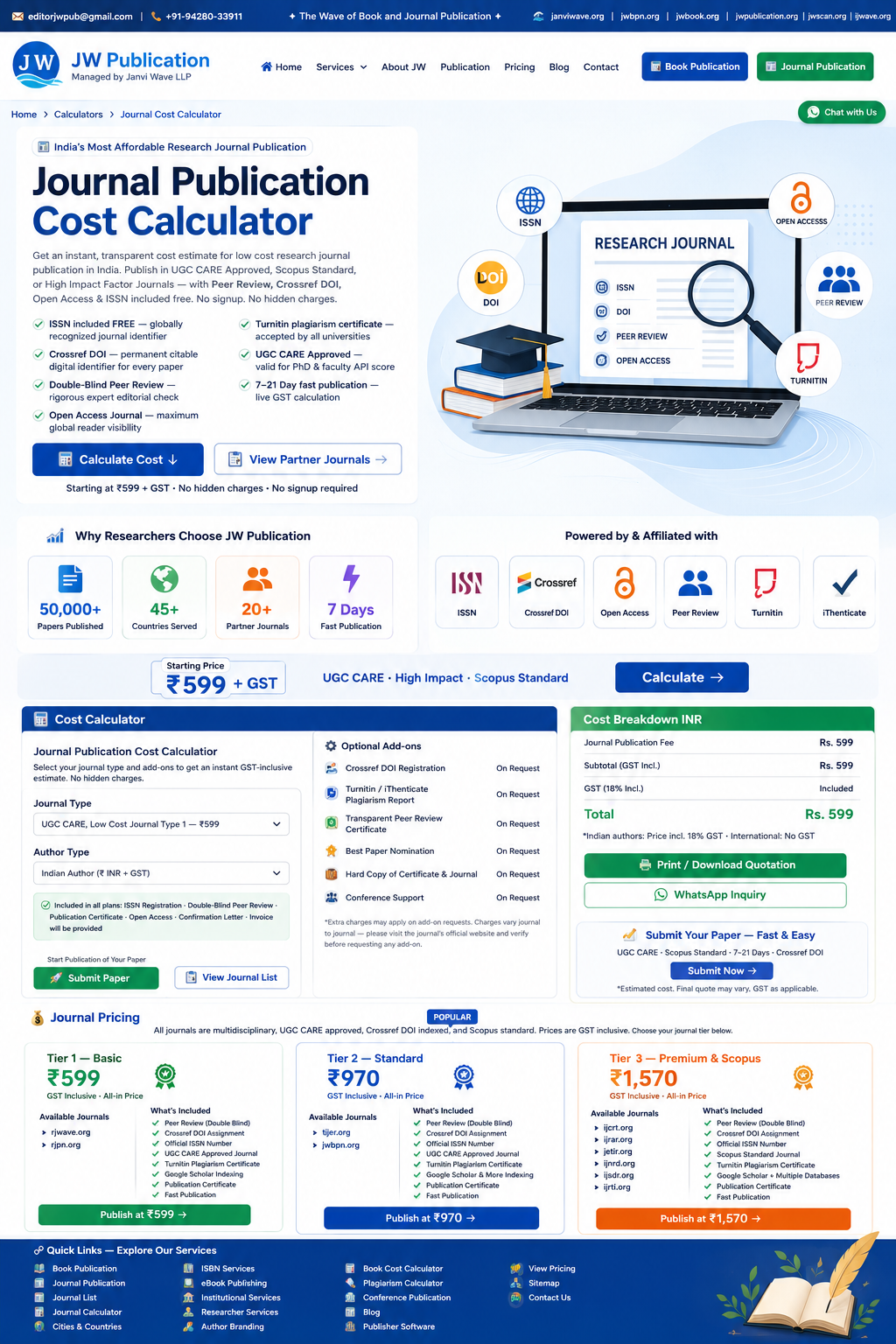
Use the Journal Publication Cost Calculator above to get an instant, GST-inclusive estimate for your research paper publication. Low cost UGC CARE Approved Journal starts from ₹599, High Impact Factor journals from ₹970, and Premium peer-reviewed journals from ₹1,570. Optional Turnitin plagiarism report available for ₹220. No signup required.
What is Journal Publication? Why Does It Matter?
Journal publication is the formal process of submitting a research paper, manuscript, or academic article to a peer-reviewed scientific or academic journal for evaluation, review, and publication. Once published, your paper becomes part of the permanent global academic record — accessible by researchers, institutions, and databases worldwide via a permanent Crossref DOI (Digital Object Identifier).
Journal publication matters for many critical reasons:
- PhD Requirements: Most Indian universities require PhD scholars to publish at least one research paper in a UGC CARE approved journal before submission of their thesis — available from just ₹599 at JW Publication.
- Faculty API Score: Under UGC guidelines, faculty members in Indian colleges and universities earn API (Academic Performance Indicator) score points for publishing in UGC CARE approved journals — directly affecting promotions.
- Research Recognition: Published papers with Crossref DOI become permanently citable, discoverable in Google Scholar, and indexed in international databases — establishing the author's global academic presence.
- Career Advancement: For industry professionals and researchers, published papers demonstrate expertise, support grant applications, and enhance professional reputation.
- Institutional Rankings: Universities and research institutions are evaluated partially on research output — publications contribute to NIRF ranking, NAAC accreditation, and global ranking parameters.
Understanding UGC CARE Approved Journal Publication in India
UGC CARE (University Grants Commission — Consortium for Academic and Research Ethics) is a quality assurance initiative by the University Grants Commission of India. UGC CARE maintains an approved list of quality academic journals — called the UGC CARE List — that meet specific standards of peer review, editorial quality, and ethics. Publication in a UGC CARE List-1 journal is officially recognized by universities and research bodies across India.
UGC CARE approved journals are important for:
- PhD thesis submission requirements in Indian universities
- Faculty promotion and Career Advancement Scheme (CAS) under UGC guidelines
- API score calculation for lecturers, assistant professors, and associate professors
- Research evaluation for NAAC, NBA, and NIRF assessments
- Government research grants and fellowship applications
At JW Publication, UGC CARE approved journal publication starts at just ₹599 INR (including 18% GST) for Indian authors — making it one of the most affordable options for researchers in India. All journals include Crossref DOI, ISSN, peer review, plagiarism check certificate, and an official publication certificate at no additional charge.
Before submitting to a UGC CARE journal, verify the journal is currently on the active UGC CARE list. JW Publication maintains verified, active UGC CARE List-1 journals. Use our journal list above to find the right journal for your discipline.
Scopus Standard Journal Publication: International Recognition for Indian Researchers
Scopus is the world's largest abstract and citation database of peer-reviewed literature, operated by Elsevier. Scopus-indexed journals are internationally recognized for their rigorous peer review, editorial quality, and research impact. While getting a paper published requires meeting quality standards, Scopus Standard journals — those that follow Scopus quality criteria — offer international visibility for research at an accessible and affordable cost.
Why Scopus Standard journals matter:
- International academic recognition beyond India's borders
- Global researcher visibility through international database discovery
- Higher citation potential due to international readership
- Accepted for international fellowship and grant applications
- Better weightage in some Indian institutions for promotion and ranking
At JW Publication, Scopus Standard journal publication starts from ₹1,570 INR for Indian authors ($60 USD for international authors) — with Crossref DOI, ISSN, double-blind peer review, Turnitin plagiarism certificate, and official publication certificate included free. However, for most Indian PhD and API score requirements, our UGC CARE approved low cost journals starting at just ₹599 are equally recognized and accepted.
Crossref DOI for Research Papers: Why Every Researcher Needs It
A Crossref DOI (Digital Object Identifier) is a permanent, unique digital address assigned to your research paper at the time of publication. Once assigned, your paper's DOI never changes, never expires, and always resolves to the published paper regardless of where it is hosted — even if the journal changes its website or platform.
Why Crossref DOI is essential for every published paper:
- Permanent Citation: Other researchers can cite your paper with its DOI, ensuring citations remain valid forever — unlike URLs which can break.
- Global Discoverability: Crossref DOI metadata is indexed by Google Scholar, ResearchGate, Academia.edu, Semantic Scholar, and all major academic databases worldwide.
- University Acceptance: Most Indian universities and research evaluation committees require a DOI for recognizing a publication as legitimate.
- Journal Quality Signal: Only journals registered with Crossref can assign DOIs — making DOI registration a marker of journal quality and legitimacy.
- ORCID Integration: DOIs can be linked to your ORCID profile, building your verified, permanent researcher identity online.
At JW Publication, Crossref DOI is included FREE in all journal publication plans — UGC CARE Approved low cost (₹599), High Impact Factor (₹970), and Premium (₹1,570). There is no separate charge for DOI registration.
Low Cost Journal Publication in India: ₹599 — What's Included?
JW Publication's commitment to affordable academic publishing means Indian researchers can publish their work without financial barriers. The ₹599 UGC CARE journal publication fee is all-inclusive — no surprise charges, no per-page fees, no author charges hidden in the process.
| Service | UGC CARE Approved (₹599) | High Impact Factor (₹970) | Premium Low Cost (₹1,570) |
|---|---|---|---|
| Journal Publication Fee | ₹599 INR / $40 USD | ₹970 INR / $49 USD | ₹1,570 INR / $60 USD |
| Crossref DOI | FREE | FREE | FREE |
| ISSN Registration | FREE | FREE | FREE |
| Peer Review | FREE | FREE | FREE |
| Publication Certificate | FREE | FREE | FREE |
| Turnitin Report (optional) | +₹220 / +$10 | +₹220 / +$10 | +₹220 / +$10 |
| Publication Timeline | 7–21 days | 7–21 days | 14–45 days |
| Review Type | Double Blind | Double Blind | Double Blind |
| Open Access | Yes | Yes | Yes |
*Indian author prices shown. All Indian author prices include 18% GST. International authors pay USD pricing with no GST. Use the calculator above for your personalized estimate.
The Peer Review Process: What Researchers Need to Know
Peer review is the cornerstone of academic publishing quality. It ensures that published research meets standards of accuracy, originality, methodology, and scholarly contribution. All JW Publication journals follow a rigorous double-blind peer review process — meaning neither the authors nor the reviewers know each other's identities during the review, ensuring impartial, bias-free evaluation.
How the peer review process works at JW Publication:
- Step 1 — Submission: Author submits the research paper in Word (.doc/.docx) or PDF format through the journal portal or via email.
- Step 2 — Initial Screening: The editorial team checks the paper for completeness, formatting, plagiarism check, and scope match with the journal.
- Step 3 — Peer Review Assignment: The paper is assigned to two or more subject-matter experts (reviewers) with relevant expertise for double-blind evaluation.
- Step 4 — Reviewer Evaluation: Reviewers assess originality, methodology, contribution, references, and academic quality. They recommend acceptance, minor revision, major revision, or rejection.
- Step 5 — Author Revision (if required): Authors address reviewer comments and resubmit with a point-by-point response.
- Step 6 — Final Acceptance & Publication: After editorial approval, the paper is formatted, typeset, assigned a DOI, published online in Open Access, and a certificate is issued.
The complete peer review and publication cycle at JW Publication takes 7–21 days for UGC CARE approved low cost journals (from ₹599) and 14–45 days for premium peer-reviewed journals — among the fastest publication timelines in India.
Turnitin Plagiarism Check for Journal Papers: Why It Matters
Plagiarism is a serious academic offense that can result in paper rejection, retraction, and permanent damage to a researcher's reputation. Most journals now require a Turnitin similarity report as part of the submission process. Turnitin is the globally recognized plagiarism detection platform used by universities, journals, and publishers worldwide.
JW Publication offers an official Turnitin plagiarism check for ₹299 INR ($10 USD) as an optional add-on to any journal publication. The service delivers an official Turnitin Similarity Report from an institutional Turnitin account within 24 hours. Features include:
- Official institutional Turnitin account report (not iThenticate or free tools)
- Similarity percentage score with source-by-source breakdown
- Grammar and writing improvement suggestions
- Accepted by all Indian universities, UGC CARE approved journals, and peer-reviewed journals
- Recommended similarity threshold: below 15% for journal submission
- Report delivered within 24 hours via email
Running a Turnitin check before submitting to a journal is a best practice that protects your reputation and significantly reduces the risk of rejection due to similarity issues.
Fast Publication in Peer-Reviewed Journals: Is It Possible?
One of the most common concerns among researchers — especially PhD scholars with thesis submission deadlines — is publication speed. Traditional high-impact journals can take 6–18 months to publish a paper. JW Publication's UGC CARE approved journals offer publication in 7–21 days while maintaining full double-blind peer review — making them ideal for researchers under time pressure.
Fast publication at JW Publication is made possible by:
- A dedicated editorial team with rapid initial screening (24–48 hours)
- An active reviewer panel covering 50+ disciplines
- Efficient revision cycles with clear reviewer feedback
- Streamlined typesetting, DOI registration, and online publication workflow
- Rush publication options available in some journals for urgent requirements
If you have an urgent publication requirement for a PhD submission or university deadline, contact us on WhatsApp and our team will guide you to the fastest available option.
PhD scholars: Our UGC CARE journals accept original research, review articles, and PhD chapter papers. Publication in 7–21 days with Crossref DOI and official certificate — accepted by most Indian universities for thesis submission. Starting ₹599.
What Types of Research Papers Can Be Published?
JW Publication journals accept a wide variety of research paper types across all disciplines. Whether you are from engineering, science, humanities, management, medical, or social sciences, there is a suitable journal in our portfolio. Accepted paper types include:
- Original Research Papers — New experimental or theoretical findings with fresh contributions to the field
- Review Articles — Comprehensive reviews of existing literature on a specific topic
- Case Studies — Detailed analysis of a specific case, event, or implementation
- Technical Notes — Short communications on technical observations or methods
- Survey Papers — Systematic surveys of technologies, methodologies, or trends
- Conference Paper Extensions — Significantly extended versions of conference papers (must be substantially new)
- PhD Chapter Papers — Individual chapters of PhD theses adapted for journal format
- Short Communications — Brief reports of significant preliminary findings
- Systematic Reviews & Meta-Analyses — Evidence-based reviews following PRISMA or similar guidelines (primarily for medical journals)
All submitted papers must be original, unpublished, and not currently under review elsewhere. Papers are processed through double-blind peer review and Turnitin plagiarism check before publication.
ISSN — What It Is and Why It's Free at JW Publication
An ISSN (International Standard Serial Number) is a unique 8-digit number assigned to a serial publication such as a journal, magazine, or newspaper. Every journal has one or two ISSNs — print ISSN and online ISSN. The ISSN is assigned by national ISSN centres and makes the journal uniquely identifiable in the international serials literature.
For authors, publishing in a journal with a registered ISSN means:
- The journal is formally registered with the international publications system
- Your paper can be correctly cited using ISSN alongside the DOI
- The journal meets a basic legitimacy threshold recognized by universities
- Your paper will appear correctly in database searches using the journal's ISSN
At JW Publication, all journals have registered ISSNs included free with your publication — there is no separate ISSN charge. ISSN details are printed on the publication certificate and on the paper's published page.
How to Submit Your Research Paper for Publication
Submitting a research paper for publication at JW Publication is straightforward. Here is the step-by-step process:
- Step 1 — Choose Your Journal: Use the journal list above to find the most suitable journal for your paper's topic and discipline. For PhD, API score, and university requirements — our UGC CARE approved low cost journals (₹599) are the most popular choice.
- Step 2 — Prepare Your Paper: Format your paper as per the journal's author guidelines (typically Word .docx). Ensure the paper is original and has not been published elsewhere.
- Step 3 — Turnitin Check (Recommended): Run a Turnitin plagiarism check before submission — available for ₹299. Ensure similarity is below 15%.
- Step 4 — Submit via Journal Portal or WhatsApp: Submit your paper through the journal's online submission portal or send it via WhatsApp/email to our editorial team.
- Step 5 — Initial Review: Our editorial team performs an initial check within 24–48 hours. You will receive a confirmation of receipt or feedback on any issues.
- Step 6 — Peer Review: Your paper goes through double-blind peer review by subject experts. Feedback and revision requests (if any) are communicated to you.
- Step 7 — Revision & Acceptance: Make revisions as recommended and resubmit. Once accepted, you receive an acceptance letter.
- Step 8 — Publication & Certificate: Your paper is published online with Crossref DOI. You receive the official publication certificate and DOI link.
Include a well-structured abstract (150–250 words), 5–8 relevant keywords, and a complete reference list in your paper before submission. Papers with proper formatting are processed faster through editorial screening.
Journal Publication for PhD Scholars in India: Key Requirements
For PhD scholars in Indian universities, research paper publication is not optional — it is mandatory. Most universities require at least one publication in a recognized journal (UGC CARE or Scopus) before the PhD thesis can be submitted. Here is what you need to know:
- Most universities require publication in a UGC CARE List-1 or better journal for PhD submission
- The publication must have a Crossref DOI and ISSN to be officially recognized
- An official publication certificate with journal name, ISSN, DOI, volume, issue, and date is required for the degree office
- Some universities require the paper to be published before the thesis submission date — not just accepted
- The paper topic should be directly related to the PhD research area
- Co-authored papers (with guide/supervisor) are generally accepted
JW Publication's UGC CARE journals (from ₹599) meet all these requirements — UGC CARE List-1 recognized, Crossref DOI included, ISSN registered, official publication certificate provided, and published within 7–21 days.
International Journal Publication from India: $40 USD
JW Publication serves researchers from 45+ countries worldwide. For international authors outside India, publication fees are priced in USD with no GST applicable:
- UGC CARE Approved Low Cost Journal: $40 USD (includes DOI, ISSN, peer review, certificate) — most popular for international authors
- High Impact Factor Journal: $49 USD
- Scopus Standard Premium Journal: $60 USD
- Turnitin Plagiarism Check add-on: $10 USD
International authors can submit papers from any country. All published papers are indexed in Google Scholar, ResearchGate, Crossref, and other global academic databases. Payment can be made via international bank transfer, PayPal, or other supported methods — contact our team for international payment options.